Current as of September 2026. Reporting rules in Asia are changing quickly. Confirm the latest position with the named regulator before you act on a deadline.
If you run sustainability, finance, or compliance for a company in Asia, you are probably asking one blunt question: do we legally have to report our climate and sustainability performance, and by when? The short answer is that mandatory climate reporting has arrived across Asia's major markets, but the start dates, the thresholds, and the fine print differ in every country. A rule that already binds a listed company in Singapore may not touch a private company in the same city until 2030.
This guide gives you the direct answer for five markets that matter most to companies operating across the region: Singapore, Malaysia, Indonesia, India, and the United Arab Emirates. Each section leads with a plain answer, then the detail. All dates are attributed to the regulator that set them.
The one-paragraph answer
Yes, climate reporting is now mandatory for large and listed companies in all five markets, but the obligations phase in over several years and target the biggest companies first. Singapore, Malaysia, and Indonesia are building their rules on the same global baseline, the ISSB standards (IFRS S1 and S2, the two international sustainability disclosure standards issued by the International Sustainability Standards Board). India runs its own detailed framework called BRSR. The UAE combines exchange-level sustainability reporting with a new federal climate law that reaches almost every business, including those in free zones. The table below is the fastest way to see where your company stands.
Mandatory climate reporting in Asia at a glance
| Market | Who is caught first | First mandatory year | Scope 3 emissions | Independent assurance | Regulator and basis |
|---|---|---|---|---|---|
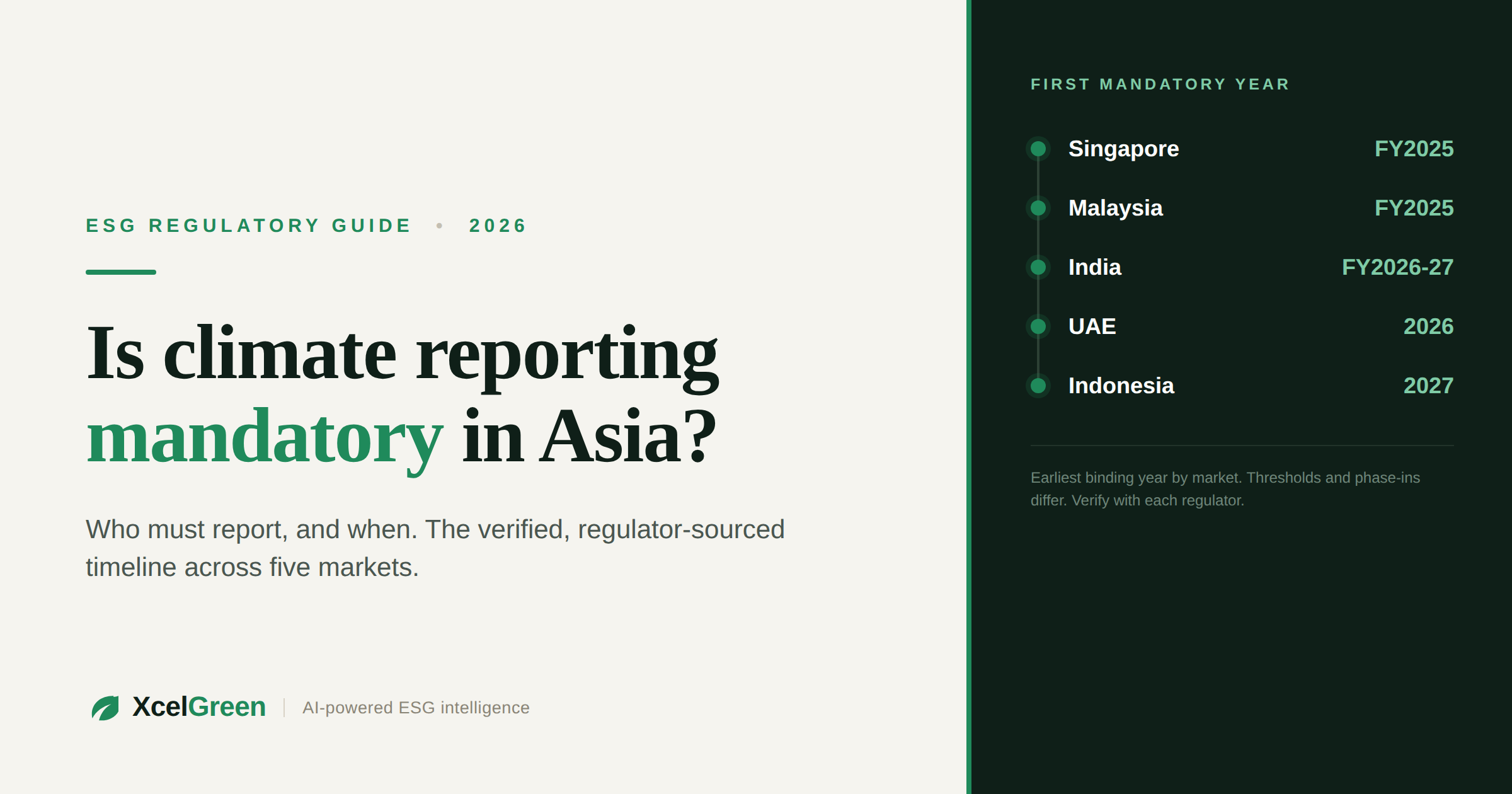
| Singapore | All SGX-listed issuers, then large non-listed companies (revenue at least S$1bn and assets at least S$500m) | FY2025 for listed issuers (Scope 1 and 2); FY2030 for large non-listed companies | Mandatory for index (STI) constituents from FY2026; voluntary for other listed companies | Limited assurance from FY2029 (listed); FY2032 (large non-listed) | ACRA and SGX, ISSB-aligned |
| Malaysia | Main Market listed issuers (largest first), then ACE Market and large non-listed companies (revenue at least RM2bn) | FY2025 for Main Market issuers with market cap at least RM2bn; 2026 other Main Market; 2027 ACE Market and large non-listed | Phased in line with IFRS S2 transition reliefs | Reasonable assurance targeted from 2027, subject to consultation | Securities Commission Malaysia and Bursa Malaysia, NSRF (IFRS S1 and S2) |
| Indonesia | Financial institutions, listed issuers, and public companies (POJK 51); new ISSB-aligned climate standard widens the net | Sustainability reports mandatory since 2019 to 2020 under POJK 51; ISSB-aligned climate disclosure mandatory from 2027 under the new SPK standard | Addressed through the IFRS S2-aligned climate standard | Still developing | OJK and the Indonesian Sustainability Standards Board |
| India | Top 1,000 listed companies by market value | BRSR mandatory since FY2022-23; assured BRSR Core reaches the top 1,000 by FY2026-27 | Value chain disclosure is voluntary | Reasonable assurance of BRSR Core: top 500 in FY2025-26, top 1,000 in FY2026-27 | SEBI |
| UAE | ADX and DFM listed companies; and, for greenhouse gas reporting, almost all entities including free zones | Listed sustainability reports already mandatory; the federal Climate Change Law took effect 30 May 2025, with full compliance by 30 May 2026 | Greenhouse gas measurement and reporting via the national MOCCAE platform | Not ISSB-mandated yet | SCA, ADX, DFM, and Federal Decree-Law No. 11 of 2024 |
First, what does "mandatory climate reporting" actually mean?
Before the country detail, here are the terms that appear in every rule, in plain language.
- ISSB standards (IFRS S1 and S2). Think of these as the global grammar for sustainability reporting. IFRS S1 covers sustainability information in general. IFRS S2 covers climate specifically. Most of Asia is adopting them so that a report written in Singapore can be read the same way in London.
- Scope 1, 2, and 3 emissions. A simple way to picture your carbon footprint. Scope 1 is your own tailpipe, the fuel you burn directly. Scope 2 is the electricity you buy. Scope 3 is everyone else's emissions in your value chain, from suppliers to the use of your products. Scope 3 is usually the largest and the hardest to measure, which is why regulators phase it in last.
- Assurance. This is an independent check of your numbers, like an audit for carbon data. "Limited assurance" is a lighter review that flags anything obviously wrong. "Reasonable assurance" is a deeper check that positively confirms the numbers are materially correct. Reasonable assurance costs more and takes longer.
- Comply-or-explain. A softer rule that lets a company skip a disclosure as long as it explains why. It is a stepping stone that regulators use before a rule becomes fully binding.
Singapore: listed companies are already in, large private companies get until 2030
Answer: Yes, and it started in financial year 2025 for listed companies. Large private companies have longer, until financial year 2030.
Singapore was one of the region's first movers, then it eased the pace. Under the requirements set by the Accounting and Corporate Regulatory Authority (ACRA) and Singapore Exchange (SGX), all SGX-listed issuers must report Scope 1 and Scope 2 emissions from financial year 2025. Constituents of the Straits Times Index (STI), the country's main stock index, must also make the wider set of ISSB-based climate disclosures from FY2025 and add Scope 3 emissions from FY2026.
The important update, which many older articles still miss, is that in August 2025 ACRA extended several deadlines. Larger non-STI listed companies (market cap at least S$1bn) now move to FY2028 for the wider disclosures, and smaller ones to FY2030. Limited assurance of Scope 1 and 2 for listed companies was pushed to FY2029. Large non-listed companies, defined as those with annual revenue of at least S$1bn and total assets of at least S$500m, were deferred to FY2030, with assurance from FY2032. ACRA cited an uncertain global economy and uneven company readiness as reasons.
The takeaway: if you are listed in Singapore, you are already reporting. If you are a large private company, you have a runway, but the direction of travel is fixed.
Malaysia: a clear three-step schedule under the NSRF
Answer: Yes, phased from 2025 to 2027, biggest companies first, under the National Sustainability Reporting Framework.
Malaysia set out one of the cleanest timelines in the region. In September 2024 the Securities Commission Malaysia launched the National Sustainability Reporting Framework (NSRF), built directly on the ISSB standards. Bursa Malaysia, the national stock exchange, applies it to listed issuers in three groups.
- Group 1, from financial year 2025: Main Market listed issuers with a market capitalisation of at least RM2bn.
- Group 2, from financial year 2026: all other Main Market listed issuers.
- Group 3, from financial year 2027: ACE Market listed issuers and large non-listed companies with annual revenue of at least RM2bn.
The framework uses the same transition reliefs that the ISSB allows, so companies can, for example, delay full Scope 3 reporting in the early years. Mandatory assurance is intended to begin around 2027, though the exact form is still subject to consultation. For a group operating in both Malaysia and Singapore, the practical point is that the two timelines do not line up, so a single reporting calendar will not cover both.
Indonesia: an older mandate is being upgraded to the global standard
Answer: Yes. Sustainability reports have been mandatory since 2019, and a stronger, ISSB-aligned climate rule becomes mandatory in 2027.
Indonesia has required sustainability reporting for longer than most of its neighbours. Under OJK Regulation No. 51/POJK.03/2017, issued by the Financial Services Authority (OJK), financial institutions, listed issuers, and public companies must publish an annual sustainability report, phased in from 2019 to 2020.
The bigger shift is now underway. The Indonesian Sustainability Standards Board finalised new Sustainability Disclosure Standards (known by the local abbreviation SPK) on 1 July 2025, adopting IFRS S1 and S2. Climate-related disclosures under this standard become mandatory from 1 January 2027, with a three-year transition period and a scope that is expected to widen to both public and private companies. In short, Indonesia is moving from its own home-grown reporting format to the same global baseline that Singapore and Malaysia use.
India: a detailed home-grown framework, now adding assured data
Answer: Yes. The top 1,000 listed companies already report under BRSR, and independent assurance of the core metrics is expanding fast.
India took its own path rather than adopting the ISSB standards directly. The Securities and Exchange Board of India (SEBI) requires the country's top 1,000 listed companies by market value to file the Business Responsibility and Sustainability Report (BRSR), mandatory since financial year 2022-23. It is one of the most detailed disclosure formats in the world, covering environment, social, and governance data in a fixed structure.
SEBI then introduced BRSR Core, a smaller set of key numbers that must carry reasonable assurance, the deeper form of independent check. This is being phased in by company size: the top 150 companies from FY2023-24, the top 250 from FY2024-25, the top 500 from FY2025-26, and the top 1,000 from FY2026-27. After industry feedback, SEBI made value chain disclosure voluntary rather than mandatory, with value chain assurance also voluntary. For an Indian listed company, the message is that the reporting itself is old news, but the pressure to prove the numbers are accurate is rising each year.
UAE: exchange reporting plus a federal climate law with real teeth
Answer: Yes, on two tracks. Listed companies already publish sustainability reports, and a new federal climate law now reaches almost every business.
The UAE has two layers. First, the Securities and Commodities Authority (SCA) requires listed public joint stock companies on the Abu Dhabi Securities Exchange (ADX) and Dubai Financial Market (DFM) to publish an annual sustainability report, drawing on international standards such as GRI and SASB, with growing reference to the ISSB baseline. These exchange rules have applied for several years.
Second, and more far-reaching, is Federal Decree-Law No. 11 of 2024 on the Reduction of Climate Change Effects. It took effect on 30 May 2025, with full compliance required by 30 May 2026. It obliges entities across the UAE, including those in free zones, to measure and report greenhouse gas emissions through a platform run by the Ministry of Climate Change and Environment (MOCCAE). Penalties for non-compliance range from AED 50,000 to AED 2,000,000. This is the widest net of any rule in this guide, because it is not limited to listed or large companies.
What these five markets share, and where they diverge
Step back and a clear pattern appears. Four of the five markets are converging on the same global standard, the ISSB baseline, which means a well-built report can increasingly serve several countries at once. That is the good news for regional groups.
The differences are where the risk sits:
- Only Singapore has publicly slowed down. Its August 2025 extensions mean any content written before then is now wrong on the dates. Everyone else has held or advanced their timelines.
- India is the outlier on format. Its BRSR is not the ISSB standard, so a group with an Indian listed arm needs a separate reporting process there.
- The UAE is the outlier on reach. Its climate law captures private companies and free-zone entities that sit outside every other country's rules in this guide.
- Assurance timing varies widely. India already demands the deeper reasonable assurance for its largest companies, while Singapore starts with lighter limited assurance only from FY2029.
For a company operating in more than one of these markets, the single biggest mistake is to assume one country's deadline covers the others. It does not.
A four-step readiness check, whatever your country
The rules differ, but the preparation is broadly the same. Here is a practical sequence.
- Confirm which rules apply to you. Check your listing status, your revenue and asset size, and every country you operate in. A single group can be caught by different rules in each market. A free reference like the XcelGreen ESG Atlas lets you compare frameworks by country and see which are mandatory versus voluntary.
- Fix your first mandatory year. Work out the earliest financial year any rule binds you, then count backwards. Data collection usually needs to start a full year before the first report is due.
- Build your emissions baseline. Start with Scope 1 and 2, which almost every rule requires first, then map your Scope 3 sources so you are ready when they phase in.
- Plan for assurance early. If reasonable assurance is coming, an assurer will want a clear audit trail. Building that from day one is far cheaper than reconstructing it later.
This is also where software earns its place. Keeping track of shifting deadlines across five regulators by hand is where teams fall behind. XcelGreen's ESG Intelligence module and its regulatory monitoring were built specifically for companies that report across ASEAN, South Asia, and the Gulf, mapping each jurisdiction's requirements to your operations so a rule change does not catch you by surprise.
Frequently asked questions
Is sustainability reporting mandatory for private companies in Asia?
Increasingly, yes, but usually later than for listed companies. Singapore brings in large private companies (revenue at least S$1bn and assets at least S$500m) from FY2030. Malaysia captures large non-listed companies (revenue at least RM2bn) from 2027. The UAE's climate law already reaches private and free-zone entities for greenhouse gas reporting.
When do I have to report Scope 3 emissions?
Later than Scope 1 and 2, and it varies. In Singapore, index (STI) constituents report Scope 3 from FY2026, while other listed companies remain voluntary for now. Malaysia and Indonesia phase Scope 3 in through the ISSB transition reliefs. India keeps value chain disclosure voluntary.
Which Asian countries have adopted the ISSB standards?
Among the markets in this guide, Singapore, Malaysia, and Indonesia are building their mandatory rules on IFRS S1 and S2. The UAE references the ISSB baseline at exchange level. India uses its own BRSR framework rather than adopting ISSB directly.
Do I need independent assurance of my emissions data?
Eventually, yes, in most of these markets. India already requires reasonable assurance of BRSR Core for its largest companies. Singapore begins with limited assurance for listed companies from FY2029. Malaysia targets assurance from around 2027. Building a clean audit trail early makes this far less painful.
What happens if my company does not comply?
Consequences range from listing and regulatory action by exchanges and securities regulators to direct financial penalties. The UAE climate law, for example, sets fines from AED 50,000 to AED 2,000,000. Beyond penalties, investors and banks increasingly ask for this data before they lend or invest.
The bottom line
Mandatory climate reporting is no longer a future problem in Asia. It is a live obligation that already binds listed companies in Singapore, Malaysia, Indonesia, India, and the UAE, and it is widening each year to reach large private companies too. The countries are converging on the same global standard, which helps, but the deadlines, thresholds, and assurance rules still differ enough that a single regional calendar will not keep you safe.
The first move is simple: find out exactly which rules apply to you, and when. You can start for free by comparing the frameworks for your country in the XcelGreen ESG Atlas, then map the requirements to your own operations from there.
Sources and further reading
The timelines above are drawn from the following regulators and primary sources. Verify the current position directly, as dates can change.
- Singapore: ACRA sustainability reporting requirements and timeline and ACRA announcement on extended timelines (August 2025).
- Malaysia: Securities Commission Malaysia, National Sustainability Reporting Framework.
- Indonesia: Financial Services Authority (OJK), Regulation No. 51/POJK.03/2017, and the Indonesian Sustainability Disclosure Standards (SPK) adopting IFRS S1 and S2 (ojk.go.id).
- India: Securities and Exchange Board of India (SEBI), BRSR and BRSR Core requirements (sebi.gov.in).
- UAE: Securities and Commodities Authority, ADX and DFM ESG disclosure guidance, and Federal Decree-Law No. 11 of 2024 on climate change via the Ministry of Climate Change and Environment (moccae.gov.ae).
- Global baseline: IFRS Foundation, International Sustainability Standards Board, IFRS S1 and S2 (ifrs.org).
Related reading on XcelGreen Insights: ISSB adoption in ASEAN markets, SGX sustainability reporting in 2026, the TCFD to ISSB transition guide, and Scope 3 emissions and supply chain carbon.